

Marketing Rebuilt #4: Customers
How to position for a buyer that isn’t human

When was the last time you opened Google.com for search? If you’re anything like me, patterns that seemed ingrained for the best part of twenty years have rapidly shifted. Perplexity is my go-to for a quick look-up whilst Claude handles the questions that require a bit of thinking alongside the search. Googling (as Alphabet well knows) is becoming less of a thing...
So we can extrapolate this. If we’re changing how we find, compare and decide... so have customers for your business. Not only that, there’s also, increasingly, a piece of software sitting one layer behind them, doing the finding, comparing and deciding on their behalf.
The first essays in the Marketing Rebuilt series looked inward: at hybrid teams, at the people on them, and at the tools they use to get work done. This one looks outward. Because the assumption underneath almost everything we do in marketing is that somewhere at the end of the funnel there’s a human making a decision. And that assumption is breaking.
Machines talking to platforms is not new, of course. APIs have shuttled structured data between systems for years. The new thing is the rise of the AI agent: software that doesn’t just move data along predetermined paths, but weighs the options, forms a preference, and acts on it (sometimes with a human approver, increasingly without). So this isn’t about a sci-fi scenario of robots-with-credit-cards: this is about what happens to marketing when the buyer delegates and the operator is not-human.
Discovery is the tip of the iceberg
The obvious place this shows up is discovery, often synonymous with answer engine optimisation (AEO). You ask ChatGPT or Perplexity to research which holiday to go on, which TV is best, what software gets the job done. And the algorithm decides whether or not a company appears.
There are plenty of guides to AEO now (even if half of them quietly claim to know more than any of us really can about what’s going on inside that black box). So if you’re wondering how to rank, go check those out. I want to dig into something more philosophical: that discovery is only the tip of the iceberg of the buying-process roles agents are taking over from humans.
A slightly dystopian but seemingly inevitable near future also includes the rise of AI personas and synthetic influencers (on TikTok, in your feed, increasingly hard to tell from the real thing). While it’s faintly vomit-inducing, it’s also clearly not going away. So discovery and curation are getting disintermediated by machine arbiters. None of them is the person you thought you were marketing to.
Underneath the plumbing, a positioning problem
The common response to all this is mechanical. How do you expose your product so agents can use it? Best practices in structuring data and writing clean documentation a machine can parse. Usage-based pricing and MCPs. All good moves, and people like Elena Verna have written very useful takes on the plumbing of opening a product up to agents.
But the plumbing sits downstream of a harder question. Who is your product actually for? And, just as importantly, what do you actually *do* for them? Not your category, not your tagline. The real deliverable, the thing of value you provide. Positioning was always the act of answering that with enough precision that the right person feels found and the wrong person wanders off.
A machine reader raises the stakes on that precision enormously. A human skim-reads your homepage generously. They round your claim up, fill the gaps with goodwill, give you the benefit of the doubt because the design looked credible and a friend had mentioned you. An agent does none of that. It takes the claim literally and goes looking for whether it’s true. Vague positioning was always a slow leak but in front of a machine that rigorously checks, it’s a burst pipe.
The agent shift doesn’t make positioning less important. It converges the job of product and marketing by making promises that don’t hold up fail faster and more visibly than before.
The whole journey is going machine-readable
Discovery and evaluation are just the front door. The next stage is the purchase phase. The rails for agents to transact are being built right now. Google launched the Agent Payments Protocol in late 2025 with sixty-plus partners. Visa and Mastercard both shipped their own agent-payment tooling. The Agentic Commerce Protocol allows people to build apps that transact in ChatGPT. Agent wallets, budgeting, and transparency reporting will come rapidly.
Pricing, once the darkest of all the GTM arts, is affected too. Why fix a price point when two agents (who are briefed with all the context and operational parameters of a business) can negotiate a mutually agreeable fee directly and optimise the invoicing accordingly? It’s boringly operational but it’s already happening in enterprise procurement. Forrester reckons a fifth of B2B sellers will face agent-led quote negotiation this year. Your counterparty across the table may already be a model and all the rules of negotiation based on human psychology will break down.
Some things will take time of course. Reasonable hesitation around reliability and human escalation creates some healthy friction. People will let an agent buy the $30 Deliveroo meal long before they let it sign a six-figure contract unsupervised. Refunds, disputes, who you actually shout at when it breaks: all of that has to exist before this goes mainstream. The direction, though, isn’t ambiguous.
Two modes
Put this story together and buying now has two modes, with different rules at each.
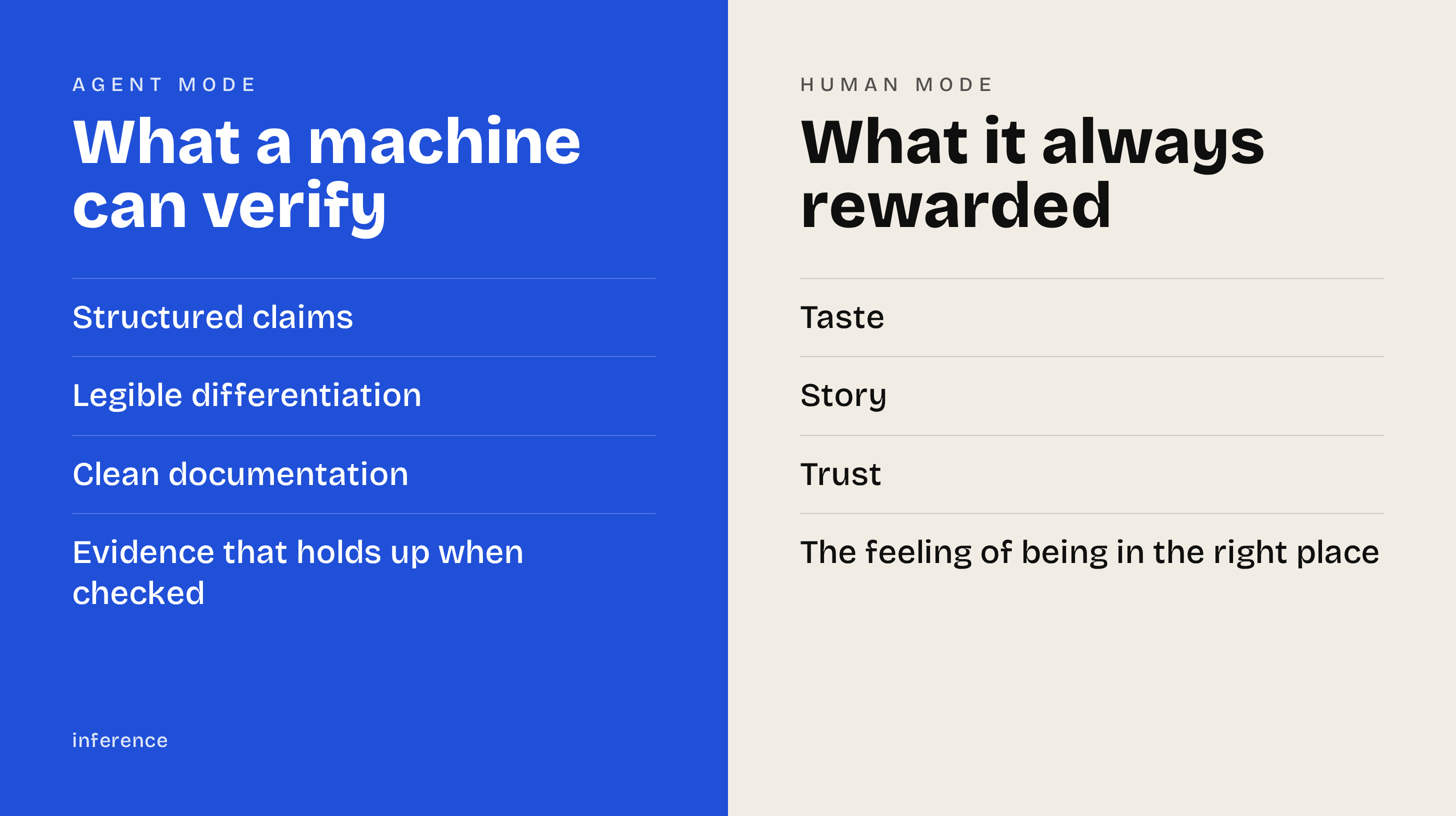
The agent mode rewards what a machine can verify: structured claims, legible differentiation, clean documentation, evidence that holds up when something actually checks it. The human mode rewards what it always has: taste, story, trust, the feeling of being in the right place.
Framed properly, this buyer shift is as much an opportunity as it is a threat. It could be the most interesting thing to happen to product and marketing in years. You get to build genuinely delightful things for the humans who’ll love them while making sure the mechanical layer underneath is clean enough that an agent can read it, trust it and recommend it. The companies that treat those as two crafts to get right, rather than a trade-off to agonise over, are the ones that’ll fly into the agentic-commerce era.
The role of the marketer is impacted by these two different modes too. There’s:
clarity for agents: structured, verifiable, legible, the discipline of making your value machine-true.
delight for humans: taste, narrative, brand, the things that don’t reduce to a spec.
developer-marketing sitting in-between, where you treat the marketing-to-a-human part as just a way to get agents on side. B2C2A?? (who doesn’t love a frivolous acronym)
What doesn’t change
For all that, don’t lose the human at the end of the chain. The agent serves a principal, and that principal still has preferences. Brand increases in importance as the filter the human applies *before* they ever send the agent shopping. It’s not about one mode or the other; it’s being mindful about how the buyer journey is evolving and optimising for each in their own separate ways.
This is the kind of fundamental realignment of marketing that doesn’t get enough airtime. While we’re all arguing about which model writes the best copy, we miss the ground moving underneath us about how customers are deciding in the first place.
Positioning has always been the act of choosing who you’re for. When “who” starts to include a machine, that act doesn’t get blurrier. It needs to get sharper. And the brands that crack that get the benefit of AI scale.
Next in the series: if the customer is changing and the tools are changing, what happens to the frameworks we’ve used to make sense of all of it? Strategy, rebuilt.