

Marketing Rebuilt #3: Building agent-ready marketing tech stacks
aka: Most of your marketing software is about to stop being worth paying for

So far in this series I’ve looked at hybrid teams and the people on them. This post is about the rather more boring, a lot nerdier, but fundamentally important question that sits underneath both. How do they actually get anything done? Which means talking about tools, and why a good chunk of them are about to stop being worth paying for.
A marketer’s typical day runs across a dozen surfaces, full of context switching and tab-pushing. Messages in Slack. Docs in Notion. Templates in Canva. A ChatGPT tab chatting away. A Zapier workflow holding some automations together. The CMS. The CDP. The CRM. God forbid we forget the CRM. The analytics dashboard nobody fully trusts. The SEO tool, the social scheduler, the project board. On and on and on.... Each one its own login, its own interface, its own monthly invoice.
Now look at what’s actually happening in each of those windows. Mostly, you’re moving structured data around. Reading a number, changing a field, approving a draft, scheduling a send. The interface exists because the operator is a human, and humans need somewhere to point and click.
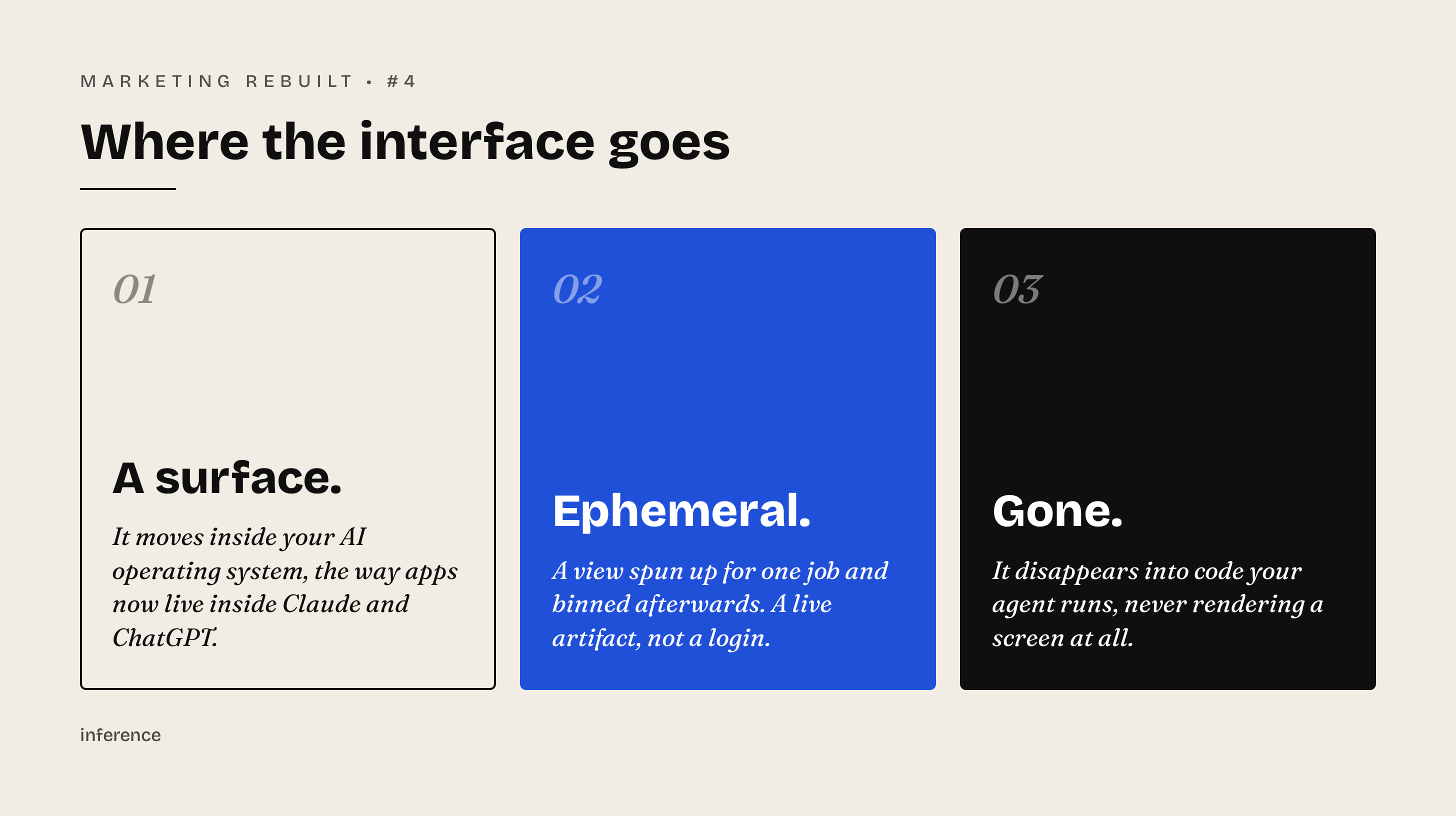
That assumption is the thing in flux. You’re not going to keep logging into a dozen separate SaaS tools the way you do today. The interface goes one of three ways. It becomes a surface inside your AI operating system (the way apps now live inside Claude and ChatGPT). It becomes ephemeral, a view spun up for one job and binned afterwards (like: live artifacts). Or it disappears into code your agent runs without ever rendering a screen at all.
Which leads to the uncomfortable core of it. Almost every marketing SaaS tool is a UI on top of structured data, and the UI is about to stop being the point.
The screen exists because the operator was a person. Once the operator is an agent, the screen is redundant. The data stays (you still need the customer records, the content, the analytics). The interface, which is most of what we relate to as the product, goes. And per-seat pricing breaks the moment your “seat” is an agent that works at three in the morning and gets through the volume of fifty people. Intercom saw this early and started charging for its Fin agent per outcome, rather than per head. The market clocked it too. February’s SaaS selloff wiped a few hundred billion off the per-seat darlings in a single stretch.
The loudest signal came in April, when Salesforce announced Headless 360, exposing the entire platform as APIs, MCP tools and CLI commands. “No browser required,” which is a remarkable phrase from the company that sold everyone a browser tab in the first place. And it’s not the only one. At the other end of the scale, Higgsfield, a new creative generation tool, shipped an MCP server at the end of April so agents can produce ad creative directly, no app to open. When the creative tools start going callable, you start to see the change that’s coming...
Let’s take a concrete example: Email. Every marketing team has an email tool. I don’t know a single one that’s happy with it. Strip them back to what they actually are and you find three things: a contacts database, a template renderer, and a sending engine. Everything else is interface. The drag-and-drop builder, the campaign dashboard, the reporting tab, all of it built for a human to point at. An agent needs none of that. Now look at something like Resend, built API-first, agent-centric, email as a callable service with the UI as the optional extra rather than the whole product. Same job, opposite shape. When your operator is an agent, you’re paying the legacy player mostly for a screen nobody logs into anymore.
The transition is one story. The more interesting question is what gets built net-new for this era. My bet is that the winners are agent-first from day one (like Resend or Higgsfield). Increasingly, every platform is releasing its own MCP servers as products in their own right. Still needed are the observability and eval layers that tell you whether your agents are any good. Permissioning and governance tooling. The shared context and memory layer the whole team reads from and writes back into, which is the foundation work I’ve written about before. Whether these layers end up being a product you buy or something you build yourself will be dependent on stage/systems, but every serious agent stack needs them.
So how do you choose, when you can’t really see the UI to compare anymore? Three things I’d weigh above the rest.
Portability: is it vendor-agnostic, does it speak open standards like MCP, can you leave without a hostage negotiation.
AI-native: built for agents to operate, not retrofitted.
Pricing: is the model aligned to value (usage, outcomes) or is it the per-seat trap that’s about to age very badly.
There’s a related move worth naming: building more in-house. When an agent can write and maintain a small tool, the build-versus-buy equation changes. The pro is obvious, something shaped to your exact use case rather than the average of everyone’s. The cons are the ones people skip past in the excitement. Maintenance, documentation and security risk don’t vanish because an AI wrote the code. So build the thing that’s truly yours and differentiating, install the plumbing that makes the system work well together, and rent the commodity.
The practical move, that I encourage folk to do as early as possible, is to audit your stack through a headless lens. This is a CMO decision now, not an ops afterthought, because it’s really a decision about how the whole function works together - similar to the org design question we posed in Essay 2. I’d audit starting with these three questions per tool.
Would we still pay for this if no human needed to log in?
Could we build a better-fitting version ourselves?
Does it set us up to scale into the agent era, or quietly lock us out of it?
A warning before you get too carried away cancelling contracts. The unwritten risk here is switching cost: ripping out an embedded tool means untangling integrations, migrating data and retraining the people who touched it. Not to mention the time needed to implement the new system. And another failure mode to be mindful of is quietly swapping tool sprawl for agent sprawl: twenty half-built agents running with nobody able to say who made them or why (I make the same point about agent teams, and it’s just as true of the stack). Governing what you build matters as much as cancelling what you buy.
The opportunity to start afresh is appealing to many marketers tired of tool sprawl.
Picture your future. You don’t open fifteen tabs. You talk to your agent. The agent talks to the tools, reads the data, drafts the work, schedules the send, and surfaces you a single view (spun up for the moment, gone afterwards) when it needs a decision only you should make. You stop being the operator and become the editor-in-chief of a system. That’s not a far-off vision. Most of the jigsaw pieces are being built right now.
---
So that’s a picture of what’s happening inside the company - tools, teams, and individuals all needing to evolve - but what about outside the company? What happens when the buyer on the other end stops being a person too...?