

Marketing Rebuilt #2: What does a marketer actually do, now?

In the last post I argued that the operating unit of a marketing team is becoming the hybrid human-agent team, designed the way you’d design a team of people. Which leaves an obvious, slightly uncomfortable question. If the team is half agents, what are the humans for? Or, the more blunt version that marketers may be asking themselves: am I going to lose my job?
It’s early days yet in this transformation but there are some pointers in the initial data. Stanford’s Digital Economy Lab did research that found early-career (the 22 to 25 bracket) roles in the most AI-exposed jobs down around 16% on employment, while their older colleagues in the same roles held steady. That’s not specifically marketing, but is a clear signal that the bottom rung is where the floor gives way first. Meanwhile PwC, working through close to a billion job ads, found the wage premium for AI skills jumped to 56% in a year, up from 25%. Fewer seats at the junior end, bigger cheques for whoever fits the new profile.
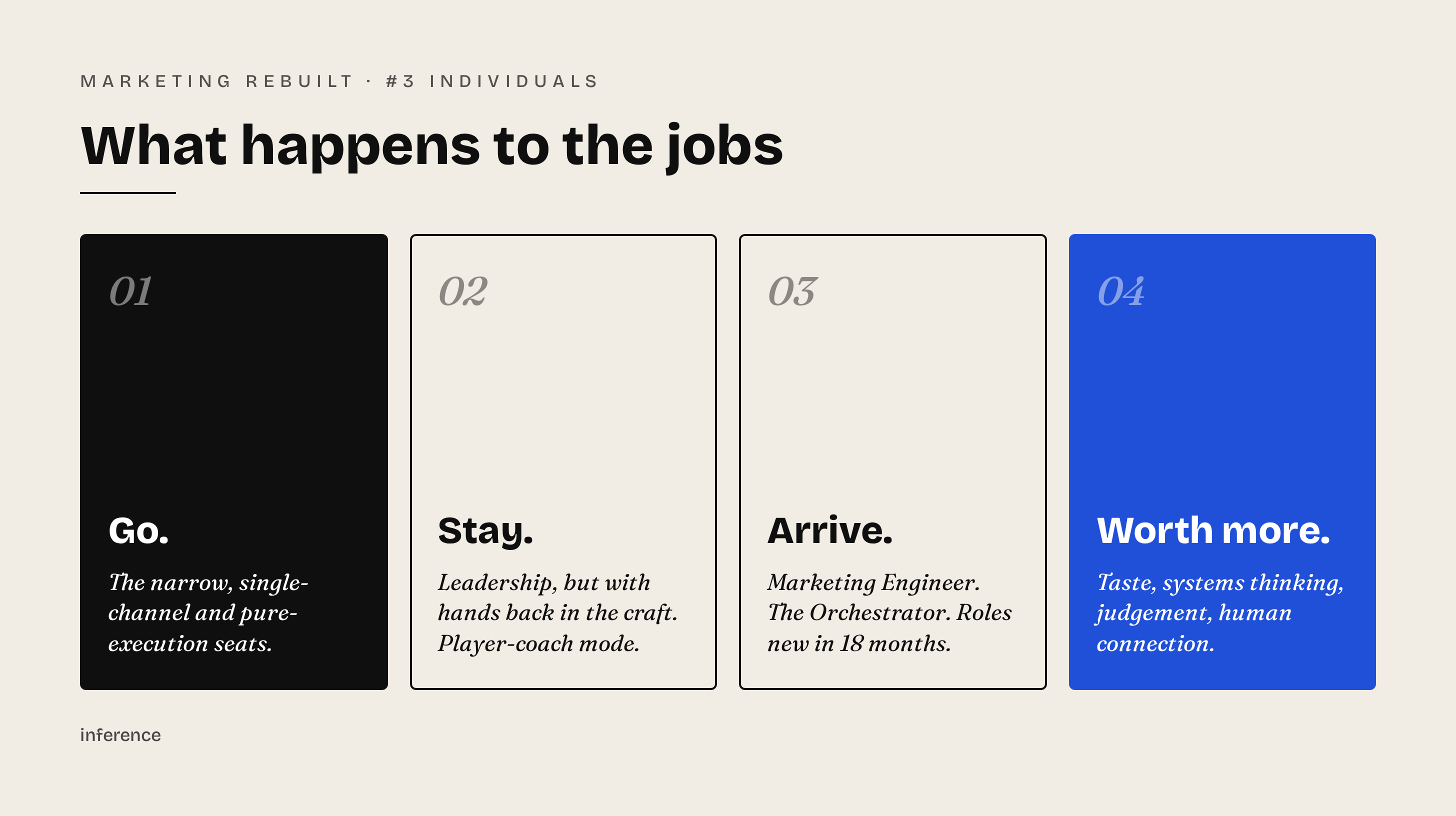
So what does the future look like? Most likely: some jobs go, some stay, some new ones arrive, and some get a lot more valuable.
The jobs that go
The most exposed roles are the narrow ones. The single-channel specialist whose whole value was knowing the inside of one ad platform. The junior execution seat where the work is producing the thing rather than deciding whether the thing is any good. If the role is “operate this tool, repeatedly, to spec,” an agent operates it cheaper and without the weekends. That’s not a judgement on value, it’s just clear where the tech is capable and the market is heading.
This is creating a problem in the market where the junior roles, that aren’t just about execution but about apprenticeship, are drying up. The roles where pattern recognition is learned by actually doing the reps, where taste gets built one mediocre draft at a time. Agents now eat exactly that work. Junior folk will need to evolve the most but luckily don’t have the sunk cost fallacy of this weird thing called a ‘career’.
The jobs that stay
Leadership stays but with a caveat. It will necessarily evolve from managing headcount and approving other people’s work to more hands-on. The leaders who come through this are the ones happy to get back into the craft, do the IC work when it’s needed, and run a team that’s part human and part agent without flinching at either. Player-coach mode. The pure people-manager who hasn’t touched the actual work in five years is in a more precarious spot than they think. (More on this in a couple of weeks in the last essay in the Rebuilt series).
The jobs that arrive
Then there are roles that didn’t exist eighteen months ago. The ones emerging right now are Marketing Engineer (being pushed hard by Profound); an evolved version of the Growth or GTM Engineer, an analytical, coding-adjacent Marketing doer. And not as common yet, but on the horizon, is the Orchestrator role (part agent-wrangler, part context-coordinator, part L&D for software). Training and refining an AI’s skills, when most companies don’t bother to do that for their human employees, sounds a tad dystopian but I wouldn’t bet against it. This is the person who keeps the agents briefed, fed with the right context, improving over time, and escalating cleanly. Even if they don’t have a name for it yet, most teams are already starting to absorb this kind of work.
The jobs that become more valuable
Some existing capabilities simply become worth more. Systems thinkers, the marketing-ops and growth people who already reason in pipes and feedback loops. People with real taste, experience and judgement (the brilliant creatives whose work you couldn’t brief out of a model if you tried). People who learn new AI systems fast. And the ones we need as everything becomes disintermediated by screens: the community, events and partnerships folk whose entire job is human connection. This only gets more valuable, not less, as everything around it commoditises.
The stack you were hired for is mostly the wrong stack
The deeper shift underneath all of it is that the skill sets that got you this far, are probably not what is going to get you hired into your next job. This isn’t the death of the marketer. Marketing has always evolved (offline to online, web to mobile) and the roles have changed with it each time. (Imagine explaining LLM-search optimisation to an 80s ad exec...).
What’s different this time is the pace of change and the fact that it’s happening inside a restless economy that’s hungry for efficiencies and board/investor pressure on GTM-team headcount.
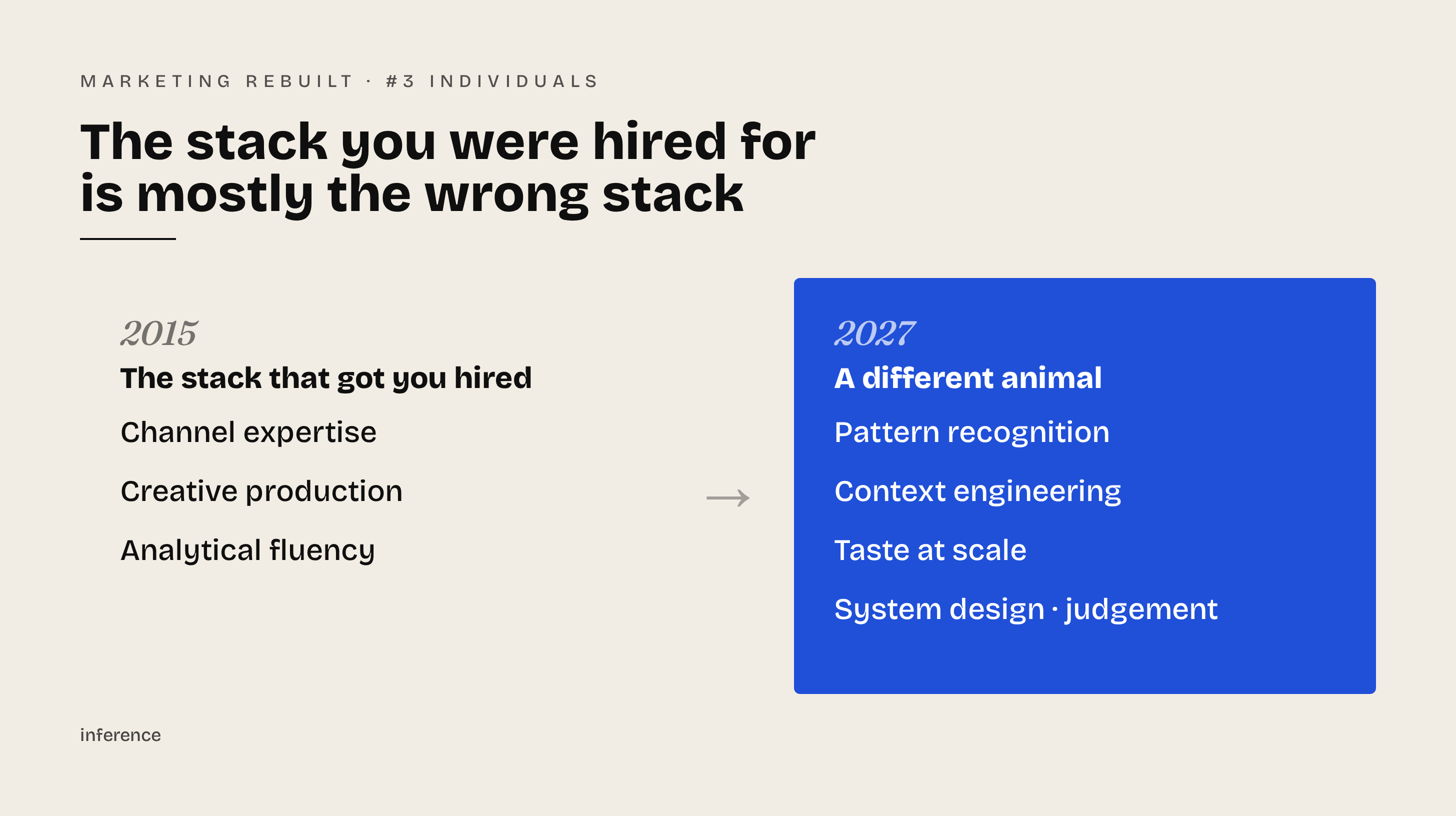
The stack that got you hired in 2015 was channel expertise, creative production, analytical fluency. The 2027 stack is a different animal. Pattern recognition. Context engineering. Taste at scale. System design. Smart judgement. The strongest marketers I know blend customer-thinking with systems-thinking, compassion with craft.
I’ll implicate myself too, while I’m at it. Almost twenty years doing marketing and, while the fundamentals remain the same, so much has changed that the last 6-12 months have been as uncomfortable and disorienting as they have been exciting and challenging.
And no, none of this means retraining as a software engineer (job prospects there don’t look too bright either!). But yes, you might have to learn GitHub.
Hiring is broken
Hiring is the part that’s most visibly broken right now. A CV and a cover letter, sent into a process where an agent screens them against a thousand other AI-generated cover letters, is not going to cut through. Anyone who’s applied for a job recently will be able to tell you about the horrific funnel maths of that.
So the advice I give people is (a cliche but:) to be more creative about it. Build things. Become known for something. Show your work in public until proving you can do the job better than anyone (robots included) is just a link you can send.
So what’s next
The job isn’t going away. It’s changing shape, faster than it’s comfortable to change with it, and the version of you that gets hired in 2027 is the one who can accept that and keep evolving.
Next week: once you’ve worked out who’s on the team and what they’re for, how do they actually get anything done? That means looking at the tools, and why a good chunk of them are about to stop being worth paying for.